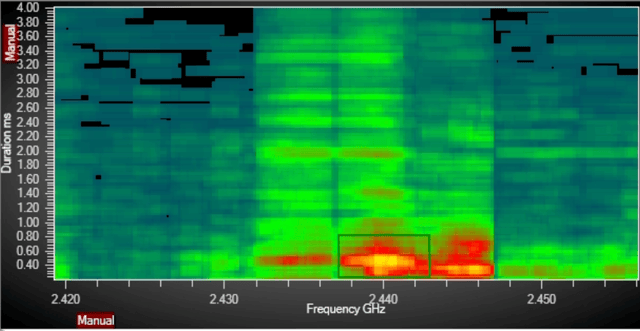
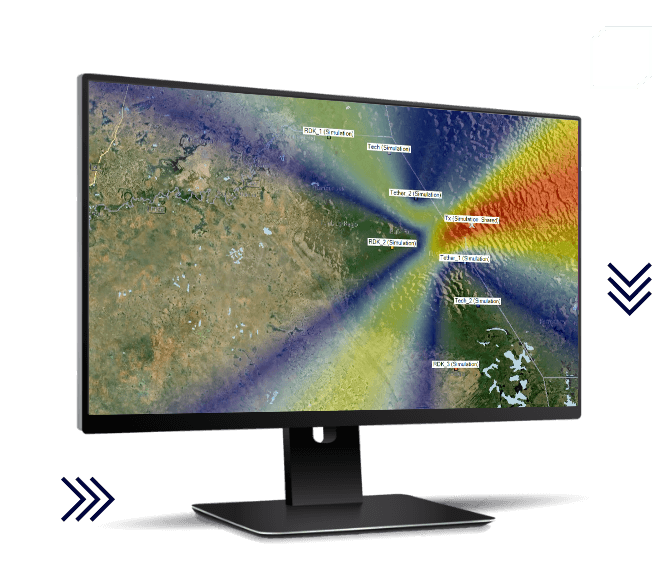
| Signal Discovery for RFeye Site reduces the cognitive load on the operator in complex and congested spectrum environments. It does so by accelerating the detection and geolocation of unknown signals in real-time through edge processing and advanced filtering techniques. |
Finding new or modified signals in the spectrum is complex and demanding. You know a signal exists, but not enough about its parameters to use standard methods. Even advanced spectrum monitoring and geolocation tools, such as building custom detectors in RFeye Site require operators to have a knowledge of the signal’s parameters.
Signal Discovery for RFeye Site
|
Don’t know the signal bandwidth?
|
Not a constraint
|
|
Unsure of the center frequency?
|
No parameter definition required
|
|
Struggling to define the pulse duration for your detector?
|
No operator input required
|
|
Concerned it’s hopping frequency?
|
Signal Discovery for RFeye Site can help
|
Signal Discovery for RFeye Site empowers operators to discover and geolocate unknown signals, combining edge processing with intuitive and easy-to-use visual signal selection. In a complex and congested spectrum environment, it reduces the cognitive load for the operator, accelerating the geolocation of time-critical threats.
How RFeye Site lightens the operator’s cognitive load
Relying on published signal specifications is risky because operators do not know what signals might be hidden. Library-based systems only confirm what you already know exists; they cannot help detect unknown, modified, or covert signals. Operators are forced to work harder with library-based systems as they are blind.
Signal Discovery for RFeye Site removes the blindfold.
Carrying out hours of manual analysis on recorded I/Q data to discover the parameters of a signal of interest and then build a detector is also risky. By the time you have found the signal of interest, the threat has become a reality.
Signal Discovery for RFeye Site removes the constraints.
Instead of using yesterday’s detector methodologies, Signal Discovery for RFeye Site allows operators to find the signals they are looking for and obtain geolocations in real time.
- Maritime domain awareness
- SIGINT for maneuver forces
Signal Discovery for RFeye Site: Reduce the cognitive load by accelerating the detection and geolocation of signals of interest with unknown parameters
- Heatmap for intuitive visualization of transmitters
- Signal filtering (inclusion or exclusion)
- Choose only signals of interest
How Signal Discovery turns complexity into clarity
Instead of searching for specific signals of interest (SOIs), based on known specifications, e.g., bandwidth, center frequency, pulse duration, modulation type, and hopping pattern, Signal Discovery for RFeye Site searches for all signals within a chosen spectrum range. It then empowers operators by providing filtering tools, which help ‘slice and dice’ received RF energy to locate transmitters.
No longer are operators faced with the paradox of having to understand the properties of a SOI to be able to detect it. Signal Discovery for RFeye Site uses patented, edge-based processing to automatically discover all pulsed signals. It then presents operators with an intuitive graphic visualization, allowing them to learn more about the SOI’s waveform and geolocate the source of the emission in real time.
Signal Discovery for RFeye Site removes
- The need to pre-define signal of interest parameters
- The reliance on manual I/Q analysis
- The uncertainty of not knowing what was missed
- The delay between detection and geolocation
- The risk caused by missing undetected signals
Conclusion
Today’s sensors detect more than operators can analyze. Library-based systems ignore anything unfamiliar, and manual analysis takes too long to matter—both place a burden on the operator.
Signal Discovery for RFeye Site reduces the cognitive load by accelerating the detection and geolocation of signals of interest with unknown parameters in real time.